
What role does centuries-old knowledge about medicinal plants play in our modern world, in medicine, in our society, and in the environment? The current exhibition “FLORA: Where Roots Give Rise to Miracles” approaches this complex question through interactive, artistic, and sensory experiences.
The exhibition was created by students at Mainz University of Applied Sciences as part of the university’s interdisciplinary collaboration with the Gutenberg Museum and the Natural History Museum, which currently share a building on Reichklarastraße and are presenting a joint exhibition for the first time. The exhibition runs from May 8 through August 23, 2026.
“The exhibition brings together science, education, and design in a compelling way”
“With FLORA, the enormous potential of collaboration between our cultural institutions and Mainz University of Applied Sciences becomes strikingly clear. The exhibition brings together science, education, and design in a compelling way, and demonstrates how the historical heritage of our city can be productively connected with contemporary scientific perspectives. it sends a strong signal for Mainz as a center of culture,” says Ludwig Holle, Head of the Department for Construction, Heritage Preservation, and Historical Heritage of the City of Mainz.
The starting point is one of the most significant works in the early history of printing: the Gart der Gesundheit (Garden of Health), printed in Mainz in 1485 by Peter Schöffer, a former associate of Johannes Gutenberg. “As an early German-language health book, it made knowledge about medicinal plants accessible to a broader public; the exhibition carries this idea forward using contemporary methods and creates a fascinating bridge to the present,” adds Dr. Ulf Sölter, Director of the Gutenberg Museum.
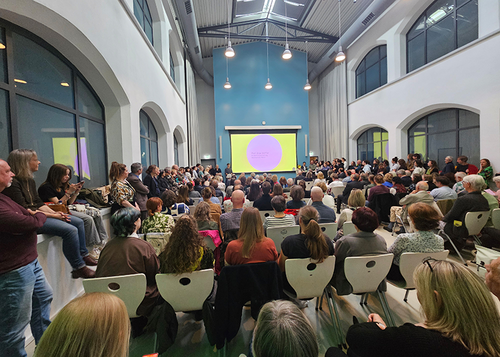
Photo: Dr. Susanne Weiß-Wittstadt – Mainz University of Applied Sciences
Interactive installations, sensory spaces, and innovative ways of sharing knowledge
Inside the exhibition, historical artifacts meet artistic, digital, and multimedia formats, from musical interpretations of herbs to health tips from centuries past, complete with a reality check. Interactive installations, sensory experience spaces, and innovative knowledge media offer visitors multiple points of access to the complex relationship between humans and nature.
“The exhibition makes visible how closely nature, science, and social developments are interconnected. Especially in light of climate change and biodiversity loss, the relevance of plants today could not be clearer,” emphasizes Dr. Bernd Herkner, Director of the Natural History Museum.
Thematically, the exhibition spans a wide range, from analyses of historical books on herbs and the role of women in natural history research to current findings on the medical use of plants and pressing ecological questions such as climate change and declining biodiversity.
“Our students have shown how scientific content can be communicated creatively and accessibly using new digital techniques”
Even before entering the exhibition, visitors are drawn into its many themes through augmented-reality herb gardens. “Our students have shown how scientific content can be communicated creatively and accessibly using new digital techniques. FLORA also represents a new form of learning that combines design, research, and social responsibility at Mainz’s hub for media and communication,” says Anja Stöffler, Professor of Digital Design at Mainz University of Applied Sciences and project head.
The innovative project is built on a broad foundation. In addition to the three main partners, contributors include the Mainz Botanical Garden, Bingen Technical University of Applied Sciences, and the Akademie Gesundes Leben in Oberursel. Together, they create a multifaceted picture of the significance of plants for humans—and vice versa.
A wide-ranging accompanying program of workshops, guided tours, and lectures deepens the themes of the exhibition and offers additional perspectives.


